Research Research publication Milestone: Dec 2025

HAIEC publishes reproducibility-focused research for AI bias audit evidence

A deterministic research architecture explores how traceable rules and cryptographic evidence can support review of automated employment tools.

2025Publication year
NYC LL144Research context
DOIArchived report
PublishedMilestoneDec 2025
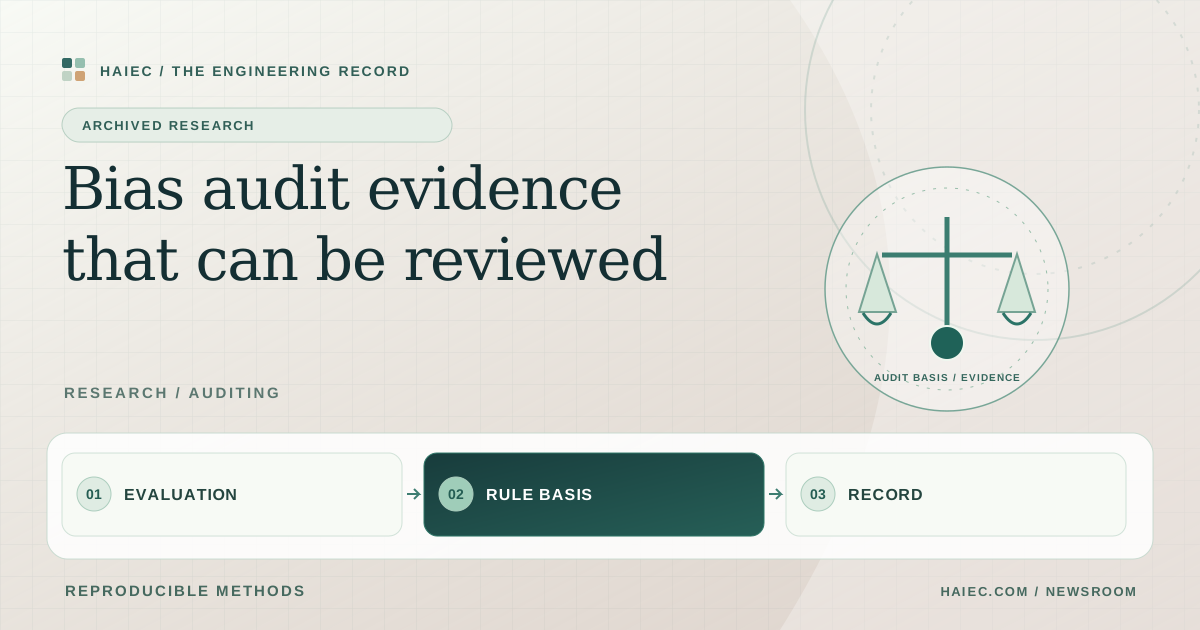
Diagram of EVALUATION to RULE BASIS to RECORD for Research / Auditing
HAIEC editorial system illustration • Vector artwork, based on the technical subject of this announcement

The technical report focuses on audit reproducibility and evidence integrity in the context of New York City Local Law 144.

At a glance

A deterministic research architecture explores how traceable rules and cryptographic evidence can support review of automated employment tools.

Reproducibility as an audit objective

HAIEC published a deterministic bias-detection technical report in December 2025, addressing evidence generation for automated employment decision tools in the context of New York City Local Law 144. The research emphasizes the role of reproducible patterns and transparent evaluation logic where organizations need inspectable audit artifacts.

From result to verifiable record

The technical architecture described in the report combines explicit rule-driven pattern checks with cryptographic evidence generation. Rather than using a language model as the final judge of whether an output meets a criterion, it emphasizes a reproducible evaluation path whose inputs, rules and outputs can be reviewed.

Scope of the contribution

The publication offers a technical research approach relevant to audit preparation. It is not itself a third-party independent bias audit, legal opinion or certification of compliance with NYC Local Law 144. The report is publicly archived and cited through its DOI.

What an audit can reproduce

Many algorithmic assessments report a result without leaving an accessible trail of the exact inputs, threshold selections, calculation basis and artifacts used to produce it. That makes an independent reconstruction difficult, especially when systems, data or methods change between review periods.

HAIEC’s December 2025 research investigates an explicitly reproducible approach to audit evidence for automated employment decision tools. The context includes New York City Local Law 144, but the research objective is methodological: make evaluated claims traceable to defined evidence and computation.

Why deterministic evidence has institutional value

A deterministic evaluation path can make disagreements more precise. Reviewers can separate a difference in the underlying dataset from a difference in the method, the implementation or the interpretation of a threshold. Versioned evidence also makes it easier to explain what was and was not assessed at a particular point in time.

The report discusses explicit checks and cryptographic evidence handling as a way to strengthen the integrity of an audit record. Those mechanisms are useful only when appropriately scoped and validated; they do not turn a report into an independent statutory audit by themselves.

From academic problem to engineering principle

The broader relevance is the transition from results to accountable records. A metric becomes more useful when a qualified reviewer can identify where it came from, how it was calculated and whether the supporting material is complete enough for the decision at hand.

This early research helped establish HAIEC’s emphasis on bounded assurance and reproducibility, principles that recur in its open-source releases and enterprise action-path evaluations. It remains a research contribution rather than legal advice or a declaration of regulatory conformity.

Editorial record

This HAIEC company announcement describes a documented milestone and links to underlying technical or public sources. Reported metrics are scoped to their referenced release or assessment; historic milestone dates do not replace this article’s publication date.
← All HAIEC announcementsTalk to HAIEC ↗