THE HAIEC PLATFORM

Know what your AI can cause.
Decide with evidence.

AI agents can call APIs, access sensitive records and trigger changes. HAIEC traces supported action paths across code, identity, authority and observed evidence, so teams can distinguish what is possible, what is permitted and what is actually proven.

DETERMINISTIC EVALUATION · EXPLICIT EVIDENCE GAPS · ACCOUNTABLE HUMAN DECISIONS

Conceptual HAIEC action, evidence, authority and consequence relationships
Conceptual relationship map. Not a live customer evaluation, observed effect or automatic enforcement claim.
THE PROBLEM

A tool permission does not tell you whether an action was authorized.

A scanner can show that code can call a refund API. IAM can show what a credential permits. Policy can define what needs approval. A log may show a call. None alone proves the complete delegation and consequence story.

Code-capableWhat the implementation can technically reach.
Effectively grantedWhat qualified credential/identity evidence makes available.
ObservedWhat authorized runtime evidence shows occurred within coverage.
Permission is not delegation. Capability is not execution. Missing evidence is not a pass.
A 20-SECOND THOUGHT EXPERIMENT · FICTIONAL EXAMPLE

The scan passed. The credential worked.
Who authorized the decision?

Explore why technically valid access and a correct security scan do not establish that an agent was delegated a business choice. This animation illustrates evidence questions only; it is not an actual test, live assessment, refund transaction or production control.

Source pathCODE-CAPABLE
CredentialGRANT EVIDENCE
DelegationUNKNOWN
Review scopeILLUSTRATIVE
SOURCE-ESTABLISHED · ILLUSTRATIVE

The code can call a refund API.

Source analysis can establish a supported callable path, not execution or authorized recipient selection.

Click the steps to reveal the distinction. The five HAIEC evidence planes are independent comparisons; these four interactions are editorial storytelling, not the evaluation workflow.

PLATFORM ARCHITECTURE

Three operating pillars.
Six independent capabilities.

Choose the capability that answers your question. Each one has its own role, evidence and integration requirements. This is not a mandatory six-step deployment pipeline.

UNDERSTANDASSUREGOVERN & OPERATE
HAIEC REVEALED / THE PLATFORM

One platform. Six capabilities. One evidence foundation.

Explore how HAIEC connects AI discovery, technical assurance, governance, operations and inspectable evidence.

Explore full platform
HAIEC / ASSURANCE ARCHITECTURE
01Discover
02Evaluate
03Authorize
04Monitor
05Protect
06Verify
HAIECEVIDENCE · AUTHORITY · CONSEQUENCE
02 / EvaluateSix independent capabilities
02 / Evaluate

See what AI could cause.

Prioritize consequential exposure using qualified sources and explicit uncertainty.

WHAT THE CUSTOMER GETSBounded assurance and security findings
See all 24 feature branches
01 / Understand

Discover: Reveal the consequential action path.

Find registered AI systems, agents, tools, source connections and code-capable relationships. Go beyond a list of endpoints to identify which downstream operations a supported implementation could reach.

The question
What can this AI system reach, call or change?
Relevant evidence
Authorized systems, connected source records, qualified code and supported tool-to-handler edges.
What this establishes
An inspectable action-capability lead, without claiming a registered component actually ran or caused an effect.
Explore System Constellation →
02 / Assure

Evaluate: Compare exact facts to defined rules.

Use canonical deterministic evaluation to compare relevant evidence about a proposed or recorded action with supported policy, technical capability, delegated authority and applicable controls.

The question
Does the evidence support the chosen action within this defined scope?
Relevant evidence
Qualified source facts, evaluation scope, operating rules, policy, identity and applicable control records.
What this establishes
Specific source-backed findings and an eligible bounded evaluation, not a universal safety verdict or inferred execution.
Explore Deterministic Assurance →
03 / Govern & Operate

Authorize: Put consequential choices under accountable authority.

Determine whether approved policy already resolves a protected choice or an exception requires bounded delegation or a decision from the appropriate human owner.

The question
Who may approve this target, amount, recipient or operating exception?
Relevant evidence
Operating policy, trusted task facts, explicit role/delegation and configured approval workflow.
What this establishes
A scoped authorization or review decision where configured, not proof that a provider credential was granted or a target-side action blocked.
Explore Delegated Action Integrity →
04 / Govern & Operate

Monitor: Investigate change in connected operating sources.

Inspect qualified logs, traces, source health and other collected runtime facts to compare known operating states and investigate changes where customers have configured supported instrumentation.

The question
What changed in the AI system and which connected source recorded it?
Relevant evidence
Authorized evidence binders, structured or OTLP ingestion, relevant baselines and source freshness.
What this establishes
A bounded change or observation in connected sources. Configuration does not prove signal receipt; receipt does not prove evaluation.
Explore Connected Evidence →
05 / Govern & Operate

Protect: Support action controls at the actual execution boundary.

Apply configured guards and qualified operator interventions to supported customer applications and gateway points. Establish which routes are actually mediated before making an enforcement claim.

The question
Can this action be held, denied, stopped or recovered by a control actually connected to the target?
Relevant evidence
Installed guard or execution adapter, authorized operator, target binding, control operation and native effect readback.
What this establishes
Supported controlled operations and their specific evidence where integrated, never universal protection from a dashboard decision.
Explore Integrated Protection →
06 / Assure

Verify: Make the evaluated result independently inspectable.

Review saved HAIEC evaluations with their exact source and scope, Agent Audits, reports and issued verification artifacts. Keep an inspectable chain between a supported finding and what a reviewer may claim later.

The question
Which result was issued, and what exact evidence and limitations support it?
Relevant evidence
Persisted evaluation identity, digest-bound reports, qualified source references and an issued receipt where available.
What this establishes
Result and artifact integrity within the specific evaluated scope, not independent certification or proof that unconnected source data is true.
Explore a Sample HAIEC Report →
Explore related product owners:PlatformAssuranceDAIControlsDevelopers
EVIDENCE-BOUND ASSURANCE

One consequential action. Five evidence questions.

What was requested, authorized, effectively granted, code-capable and observed?

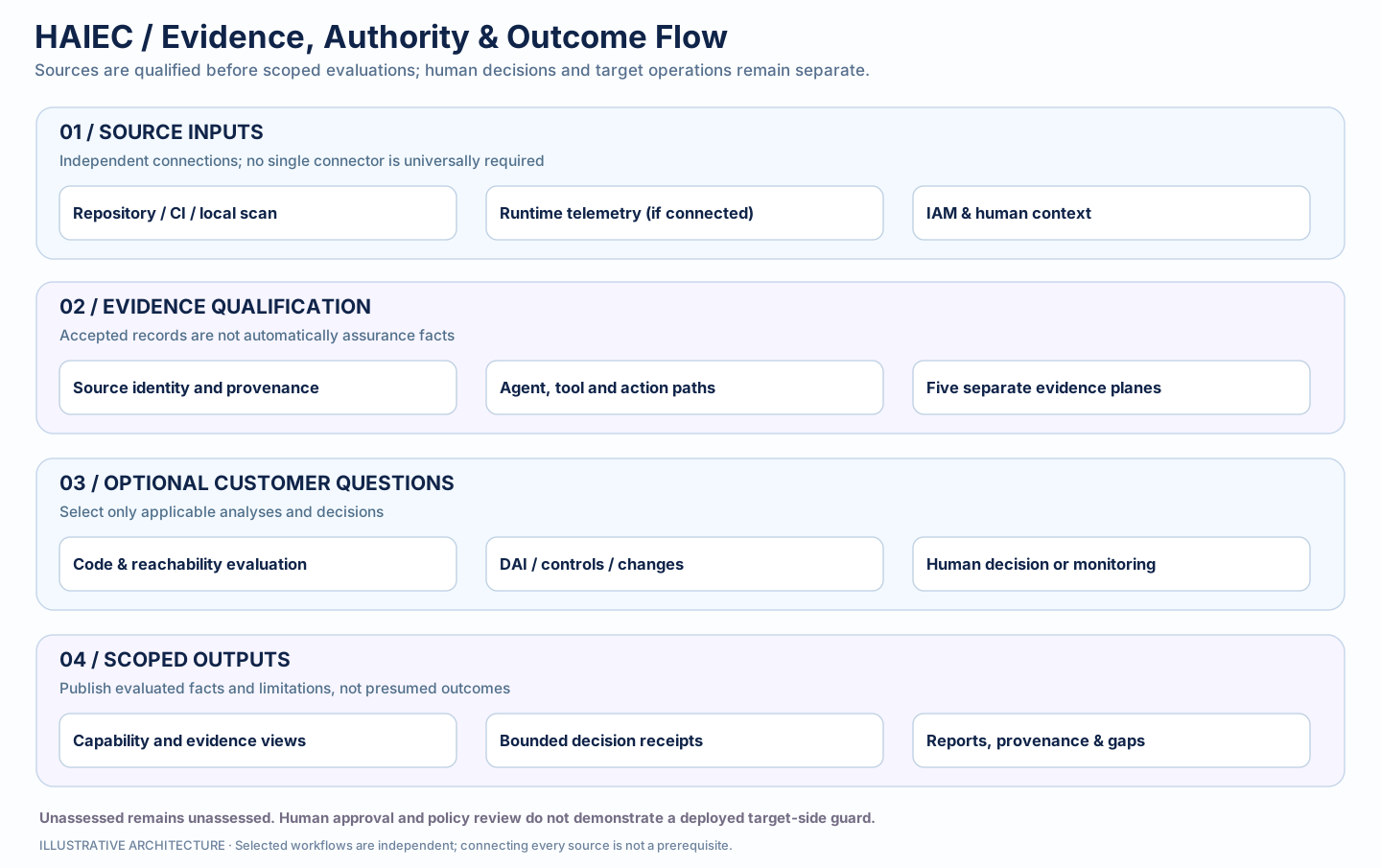
HAIEC compares these independently qualified dimensions against a bounded question. A detected action path is not automatically delegated, executed or proven to have changed a target.

Explore the methodology →

What you can review

  • Action and access map within supported coverage
  • Deterministic evaluation and missing evidence
  • Human decision records where configured
  • Scoped reports and verification artifacts

Illustrative example: A support agent can call a refund endpoint, but the evidence does not establish delegated authority to choose the recipient. That is a review question, not a universal safe verdict.

AGENT-NATIVE ASSURANCE · REAL DOCUMENTED ENTRY POINT

Already using an AI agent?
Let it operate HAIEC.

Connect the remote HAIEC MCP server once, then ask your compatible coding assistant to check what's available. The AI guides authorized tool calls; HAIEC's canonical evaluator owns the findings. A scoped HAIEC key and compatible client are required. Setup can report missing prerequisites rather than pretending to run a scan.

Streamable HTTP MCP endpointhttps://www.haiec.com/api/mcp
Main intent prompt · four wordsRun HAIEC AI Assurance

Authenticate with a scoped Bearer API key in your agent client's private connection settings, not this page or a chat prompt. The agent should run read-only preflight first. A verified source, eligible system, permissions and consent are needed for an actual scan.

GET STARTED

Start with one system and one consequential question.

Use the workspace, supported connected GitHub sources, Assurance API or MCP-enabled assistant. Extra runtime and authority evidence is added only when the decision requires it.

Monitoring and target enforcement depend on supported customer integrations; a decision receipt alone cannot stop a tool call.