Research Framework update Milestone: Oct 2026

HAIEC presents ISAF v2: connecting the instruction stack to consequential AI actions

The public framework extends AI accountability from instruction lineage toward authority, choice, implementation and effects.

v2.0Author-issued framework
5Evidence planes
PublicFramework available
PublishedMilestoneOct 2026
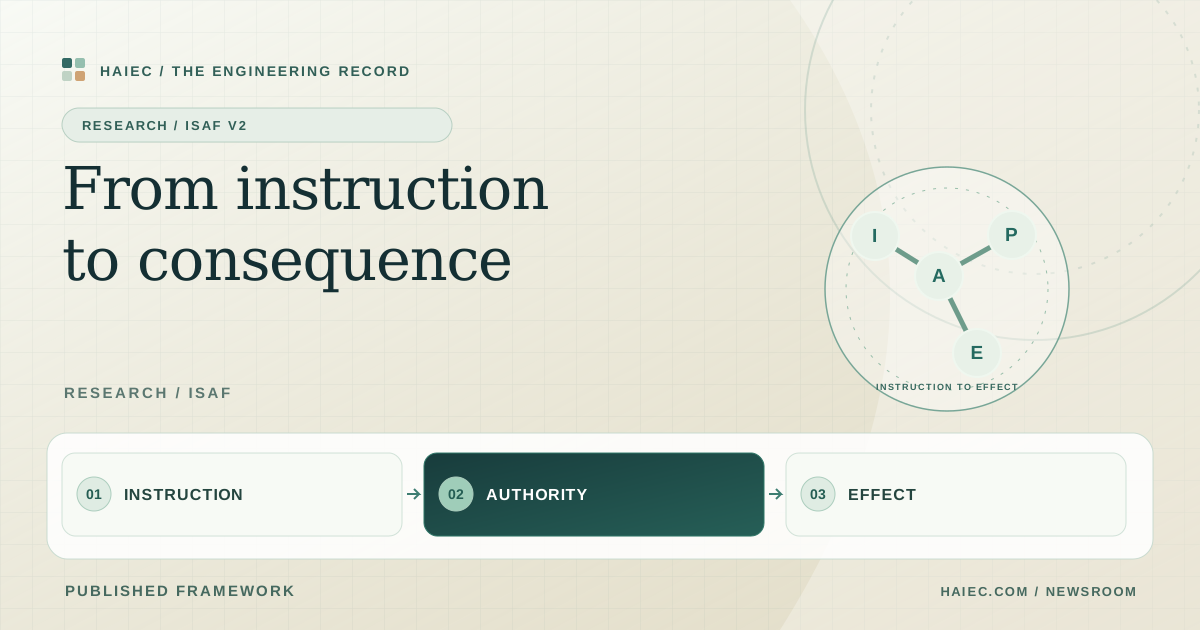
Diagram of INSTRUCTION to AUTHORITY to EFFECT for Research / ISAF
HAIEC editorial system illustration • Vector artwork, based on the technical subject of this announcement

ISAF v2 connects instruction origins, delegated discretion, actionable capability and evidence without collapsing separate accountability questions.

At a glance

The public framework extends AI accountability from instruction lineage toward authority, choice, implementation and effects.

From instruction provenance to consequence

HAIEC has made its ISAF v2 framework publicly explorable. The research model follows the path from system instructions and contextual influences through an AI agent’s tools, possible delegated choices and consequential effects. The central proposition is precise: possessing technical permission does not necessarily establish that an AI system was delegated the authority to make every business decision inside an action.

Distinct questions, one connected model

ISAF v2 distinguishes requested action, policy authorization, effective grants, implementation capability and observed activity. These evidence planes help reviewers avoid equating a tool definition with actual execution, or access permission with the authority to select a consequential outcome. The public framework also relates instruction lineage to action paths and decision evidence.

Publication status and research direction

ISAF v2 is currently an author-issued public research framework. Archival manuscript publication and external peer review remain separate milestones. The newsroom describes the available methodology now, while reserving a formal paper-publication announcement for its completed archival release.

From prompt hierarchy to operational authority

Modern agentic systems assemble behavior from system instructions, developer configuration, retrieved material, user requests and connected tools. A prompt or instruction can influence a model, but the consequences of that influence depend on the permissions, code paths and decision rights that surround the agent. ISAF v2 gives those dependencies a coherent audit frame.

The framework separates a policy that permits an action from the authority to make a consequential choice. A model may technically possess write access while lacking the delegation required to alter a financial record, approve a customer exception or expose protected information.

The evidence questions remain distinct

ISAF v2 can be used to organize inquiry across requested action, policy authorization, effective grants, code capability and observed behavior. These are distinct evidence planes. A permitted API call is not proof that the application made the call; a logged call is not automatically proof that the target system accepted and applied the intended change.

That separation encourages more exact reporting. An assessment can identify a source-visible capability with high confidence while leaving policy or effect evidence unresolved until the relevant system owner supplies it. The method is valuable because it clarifies what can be concluded and which evidence would change that conclusion.

Research publication and practical application

The public ISAF v2 page presents the extended conceptual framework. The final author-issued manuscript and future archival release are separate publication steps, so the newsroom should not claim a journal acceptance, peer-reviewed publication or new DOI before one exists.

The intellectual direction complements HAIEC’s platform: instruction provenance and behavioral influence become inputs to the broader question of delegated action integrity. Together they support governance teams that must explain not only what an AI generated, but why an ensuing operational decision was within legitimate authority.

Editorial record

This HAIEC company announcement describes a documented milestone and links to underlying technical or public sources. Reported metrics are scoped to their referenced release or assessment; historic milestone dates do not replace this article’s publication date.
← All HAIEC announcementsTalk to HAIEC ↗