Engineering Platform update Milestone: 21 Oct 2026

HAIEC expands its code-backed catalog for deterministic AI security and assurance

A versioned catalog of executable rules, detection families and remediation guidance strengthens the engineering foundation behind assurance.

176Detection rules
157Executable rules
31Detection families
PublishedMilestone21 Oct 2026
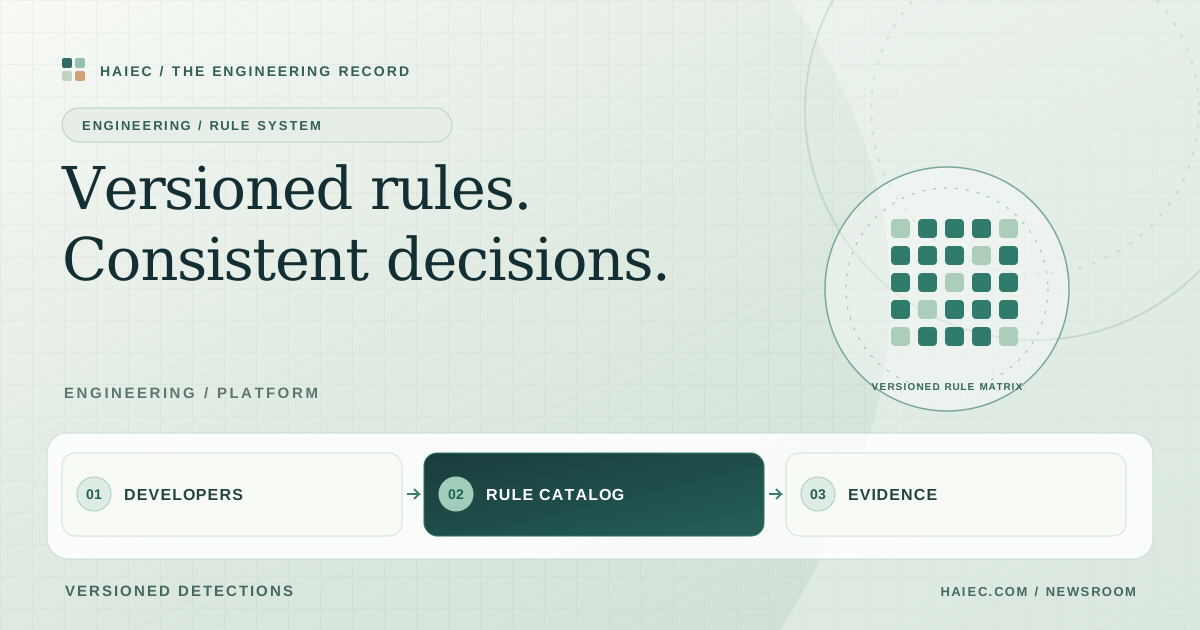
Diagram of DEVELOPERS to RULE CATALOG to EVIDENCE for Engineering / Platform
HAIEC editorial system illustration • Vector artwork, based on the technical subject of this announcement

The shipped developer catalog offers an inspectable set of deterministic detections, remediation playbooks, telecom entities and semantic relations.

At a glance

A versioned catalog of executable rules, detection families and remediation guidance strengthens the engineering foundation behind assurance.

Cataloged engineering, not improvised verdicts

HAIEC’s developer capability catalog exposes versioned detection rules, families and remediation playbooks used to examine AI application surfaces and their security context. The catalog is tied to shipped code and is designed to keep developer-facing inventories aligned with the corresponding implementation rather than relying on a separate marketing count.

The October 21 snapshot

The public changelog build recorded on October 21, 2026 lists 176 detection rules, 157 executable rules, 31 detection families, 17 remediation playbooks, 17 telecom entity types and 113 semantic relation types. Counts are a dated snapshot of the catalog and may change as the underlying product evolves. Catalog availability is not identical to deployment, enablement or runtime operation in every customer environment.

Why repeatability matters

HAIEC’s deterministic assurance model treats evidence qualification and explicit rule semantics as the decision basis. AI assistants can help initiate workflows and interpret results, while the authoritative evaluation stays anchored to the available scope, evidence and shipped rules. That distinction helps users compare results across an IDE, API and assurance workspace without changing the criteria based on how the question was asked.

A shared technical vocabulary for assurance

When every dashboard, assistant or developer extension maintains its own definition of a security finding, the resulting reports can drift apart. One team sees a risk label, another sees a partial pass, and the reviewer has no stable rule version to reconcile the difference.

HAIEC’s catalog strategy is to make the implementation itself the source for rule definitions, detection families and remediation guidance. That approach supports a more consistent account of which check ran, what it evaluated, and which evidence was available in the assessed code or configuration.

An auditable change history

As of the October 21 changelog snapshot, the public developer catalog reported 176 detection rules, 157 executable rules, 31 families and 17 remediation playbooks, together with a telecom-oriented entity and relation vocabulary. These are catalog inventory figures; they are not a claim that every rule is enabled or applicable for every organization.

Version-bound release records help security teams understand why two results may differ. A changed detector, newly supported framework, additional code source or revised remediation playbook can alter what the system identifies. The catalog offers an accountable reference for that evolution.

Connection across developer and enterprise workflows

Developers can encounter these findings early, while working in a repository or connected tool. Enterprise assurance teams then need a richer interpretation: which application action is reachable, what authority has been established, which control applies and what evidence exists for the target consequence?

HAIEC’s product positioning preserves that distinction. The developer catalog contributes technical evidence. The deterministic assurance evaluator produces conclusions only from the qualified inputs available in its scope, whether initiated through the workspace, API or supported MCP path.

Editorial record

This HAIEC company announcement describes a documented milestone and links to underlying technical or public sources. Reported metrics are scoped to their referenced release or assessment; historic milestone dates do not replace this article’s publication date.
← All HAIEC announcementsTalk to HAIEC ↗