HAIEC worked in a 40-team global challenge alongside the wider enterprise technology ecosystem, moving beyond AI trust claims to inspectable assurance evidence.
At the AT&T-hosted global challenge, HAIEC applied its deterministic assurance engine to telecom agent forensics and published a 506-file, integrity-verifiable technical record.
Engineering AI trust in a world-first industry setting
HAIEC participated in TM Forum’s Trustworthy AI and Data Hackathon at Innovate Americas in Dallas, hosted at AT&T headquarters. TM Forum described the global event as a world-first industry challenge, bringing together more than 200 developers across 40 teams to establish whether autonomous agent activity can be governed, explained and independently verified. The wider industry forum included major enterprises such as Accenture, Infosys and Tech Mahindra, demonstrating the caliber and reach of the competitive and technical environment. HAIEC took part independently, without a claimed partnership or organizer endorsement.
An independent deterministic assurance contribution
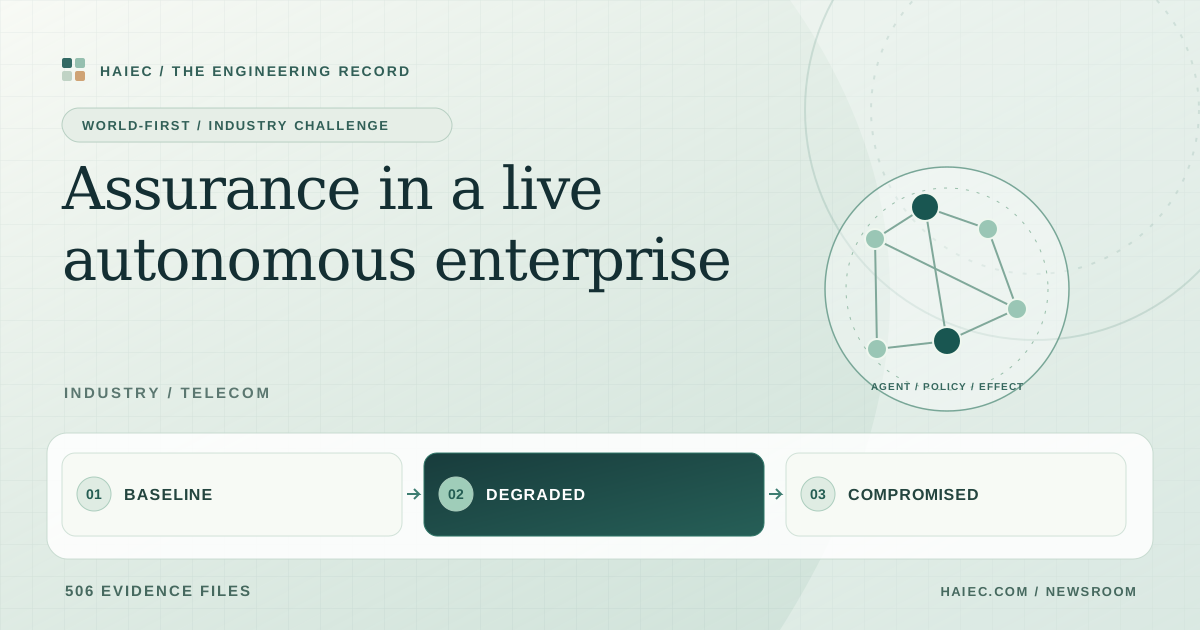
Working in the AWS-supported agentic telecom simulation, HAIEC used its own deterministic assurance engine and method to investigate delegated actions, policy alignment, evidence sufficiency and consequential behavior across escalating baseline, degraded and compromised scenarios. HAIEC reports completing its planned assurance workstream across the challenge’s baseline, degraded and compromised scenarios. The independent engine and published evidence package establish the team’s technical contribution without asserting organizer-certified completion of every control.
An inspectable, integrity-verifiable engineering record
HAIEC subsequently published a frozen technical reference package containing 506 manifest-listed evidence files with SHA-256 verification. The materials include control states, run traces, enforcement and monitoring evidence, investigative workbench artifacts and known limitations. The source repository distinguishes archive integrity from organizer-submission identity; the latter cannot be independently established from the repository alone.
A contribution in a global competitive environment
The challenge placed HAIEC’s independent engineering work in a high-caliber global environment alongside the wider ecosystem of systems integrators and technology firms. TM Forum recognized Infosys Infyvibes as the overall winner. HAIEC’s distinctive contribution is its deterministic assurance engine, a documented operational method and an independently inspectable evidence archive that can be adapted to other consequential AI settings.
The same arena as established technology leaders
Innovate Americas 2026 convened a substantial cross-section of the telecommunications and enterprise technology market. The official event roster included Accenture, Infosys and Tech Mahindra, with AT&T serving as the hackathon host. For an independently built assurance engine, participating in this environment supplied a meaningful test of technical relevance: could the method translate from an architecture claim into a functioning investigation of autonomous operations?
HAIEC approached the event as a forensic and assurance engineering exercise, not a model-prompting contest. Its central question was whether actions taken through delegated tools could be reconstructed against available policy, implementation and observed evidence. That distinction matters in telecommunications, where a seemingly narrow instruction can traverse identity systems, network controls and business workflows.
A structured evaluation across increasing levels of adversity
The challenge environment was designed to expose teams to changing operating conditions. HAIEC organized its work around a baseline state, a degraded state and a compromised state, described in the team record as AL0, AL1 and AL2. Each state demands a different kind of judgment: establishing the legitimate operating path, recognizing when important assurance signals are weakened, and identifying what remains demonstrable when trust assumptions are challenged.
The deterministic engine supplied the organizing discipline. Teams could compare intended authority with effective grants, inspect available source paths, evaluate whether an action was reachable, and distinguish recorded activity from a verified target effect. HAIEC reports completing its scoped workstream across the levels and published artifacts that show its approach. That statement reflects the team’s own documented work, not a separate TM Forum certification of every control.
A permanent technical record beyond the competition
The public release archives 506 manifest-listed files and provides SHA-256 verification for the frozen contents. The package includes run identifiers, control-test records, evidence traces, a LogSense workbench bundle, security findings and known limitations. Readers can check whether the published files match the stated manifest rather than being asked to rely exclusively on a promotional summary.
The engineering relevance extends beyond one event. Evidence with explicit scope, dates, identities and qualification rules can be reviewed again, compared against different control objectives and incorporated into later assurance work. Archive integrity is demonstrable; a byte-for-byte match to the organizer’s submission is not established by the public repository alone.
From a hackathon to a repeatable enterprise discipline
The broader field is moving toward autonomous customer, network and operational systems. HAIEC’s thesis is that organizations need an independent record of what those systems were authorized to decide, what implementation paths were available, and what behavior was actually evidenced. In the absence of that record, even highly capable agents can leave governance teams with little more than dashboards and retrospective inference.
TM Forum’s announcement named the Infosys Infyvibes team as the event winner. HAIEC’s achievement is different and concrete: participation at industry scale, use of its own deterministic engine and publication of inspectable technical evidence. The episode demonstrates a research-to-engineering trajectory and provides material for enterprise buyers to evaluate the approach on its merits.
This HAIEC company announcement describes a documented milestone and links to underlying technical or public sources. Reported metrics are scoped to their referenced release or assessment; historic milestone dates do not replace this article’s publication date.