Open Source Open-source release Milestone: 22 Aug 2026

HAIEC releases LLMVerify to make deterministic model I/O protection available to developers

Local-first LLM input/output verification and redaction extend HAIEC’s developer security coverage to runtime content risks.

1.6.1Documented npm version
Local-firstStandard checks
MITOpen-source license
PublishedMilestone22 Aug 2026
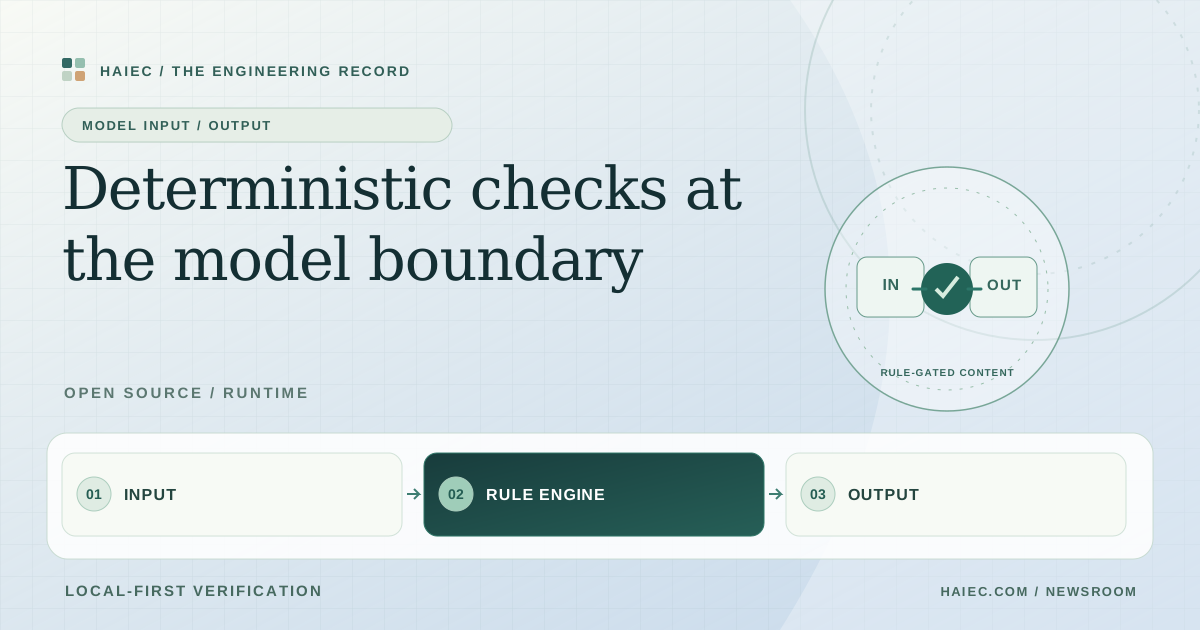
Diagram of INPUT to RULE ENGINE to OUTPUT for Open source / Runtime
HAIEC editorial system illustration • Vector artwork, based on the technical subject of this announcement

The MIT-licensed LLMVerify toolkit brings pattern-based prompt injection screening, PII inspection and explicit limitation reporting into everyday application workflows.

At a glance

Local-first LLM input/output verification and redaction extend HAIEC’s developer security coverage to runtime content risks.

Extending security into the model interaction surface

HAIEC released LLMVerify as a developer-friendly toolkit for checking model input and output streams at runtime. Source scanners cannot observe the text that a model eventually reveals, while tenant-boundary analysis does not determine whether an output contains a recognizable personal-data pattern. LLMVerify addresses that narrower and complementary security surface.

Built for practical and inspectable use

The MIT-licensed Node.js package provides local verification through an SDK, CLI and local HTTP interface. Its pattern-based baseline detects configured prompt-injection signatures, common PII formats and selected risk indicators without requiring an online model judge for those baseline checks. Results expose what was checked and what was outside scope.

Part of an independently usable security toolchain

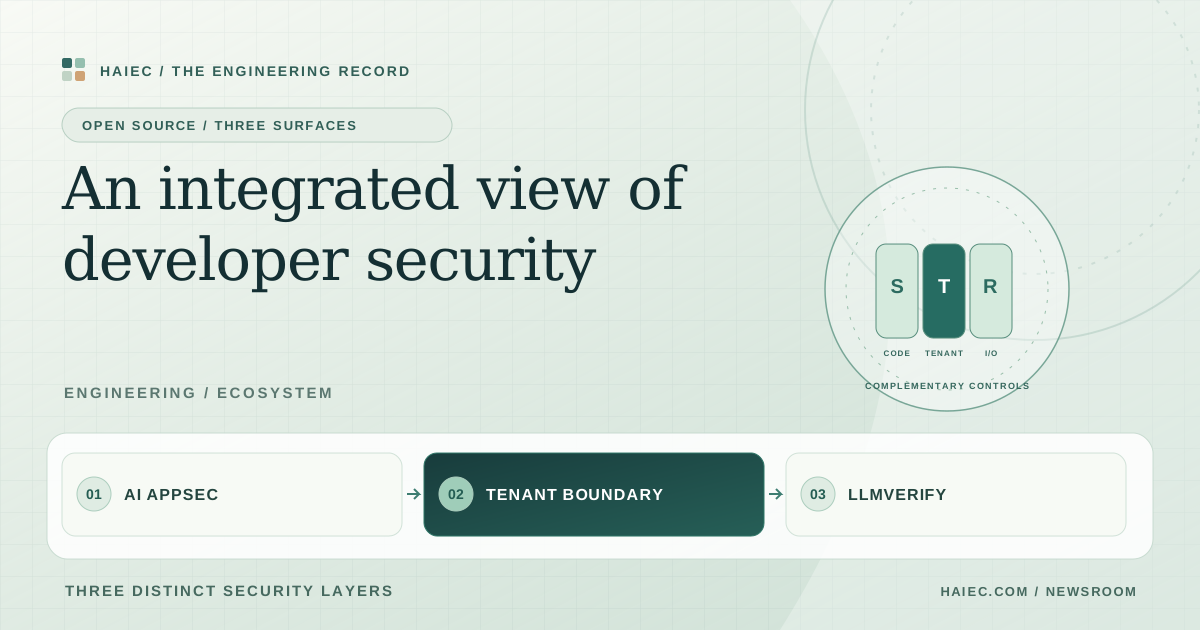
LLMVerify is part of HAIEC’s open-source developer security portfolio alongside AI AppSec and MCP Tenant Isolation. Each can be adopted independently. Evidence generated by source, tenant and model I/O tools may inform wider assurance, but no single scanner is represented as a complete enterprise governance decision.

The overlooked boundary between code and model behavior

Traditional application security tools can analyze a repository and still miss a problematic model response. A retrieval flow may be syntactically correct and properly integrated, while the language model includes personally identifiable information in an answer. The failure mode appears in the runtime content, not necessarily in a recognizable source-code vulnerability.

LLMVerify was introduced to provide developers with direct checks at this boundary. It can be placed around model input and output paths, where a configured rule engine evaluates content and returns an inspectable result before the application decides how to proceed.

Local-first by design

The baseline package is designed to run locally, without submitting every evaluated prompt or response to another online model. The documented interfaces include a JavaScript SDK, CLI and local HTTP integration. This architecture is particularly relevant to developers who wish to avoid routing sensitive application content through an additional scoring service.

Deterministic verification also allows teams to put known checks under source control, compare behavior against the same inputs and rule versions, and examine the specific condition that caused a finding. It is a practical engineering foundation rather than a claim that all unsafe content is detectable.

How the results should be used

The appropriate response to a flagged result depends on the product workflow. A developer might block a specific output, redact an identified pattern, request review or create a traceable alert. LLMVerify provides a scoped signal, while the consuming application remains responsible for handling that signal and assessing broader security requirements.

The package complements source-level and tenant-level security work. By releasing independently usable tools with clear boundaries, HAIEC gives builders a way to adopt targeted controls without conflating a detector result with a complete enterprise assurance verdict.

Editorial record

This HAIEC company announcement describes a documented milestone and links to underlying technical or public sources. Reported metrics are scoped to their referenced release or assessment; historic milestone dates do not replace this article’s publication date.
← All HAIEC announcementsTalk to HAIEC ↗