Open Source Open-source release Milestone: 21 Aug 2026

HAIEC strengthens MCP tenant-boundary verification with Tenant Isolation 2.0

Deterministic checks and provenance-oriented outputs help developers evaluate cross-tenant exposure in MCP-enabled systems.

57Deterministic rules
203Release tests
2.0Major version
PublishedMilestone21 Aug 2026
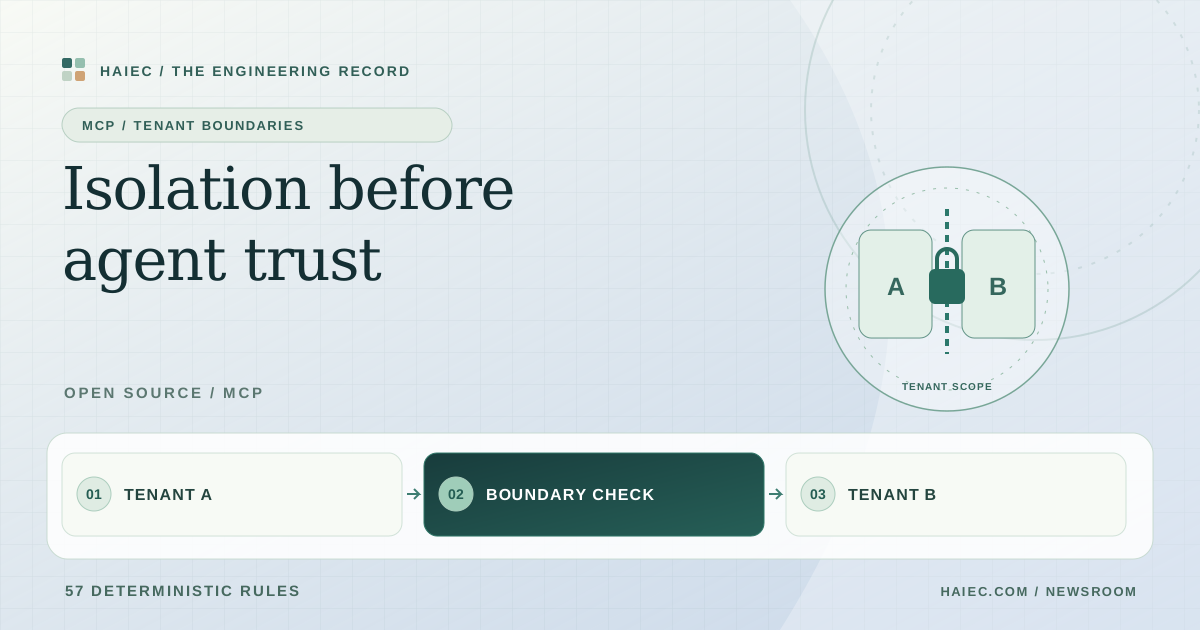
Diagram of TENANT A to BOUNDARY CHECK to TENANT B for Open source / MCP
HAIEC editorial system illustration • Vector artwork, based on the technical subject of this announcement

The 2.0 release brings updated MCP SDK support, enforced path boundaries, structured evidence output and trusted publishing.

At a glance

Deterministic checks and provenance-oriented outputs help developers evaluate cross-tenant exposure in MCP-enabled systems.

Tenant boundaries are distinct from tool trust

A trusted MCP server can still mishandle tenant scoping. In August 2026, HAIEC documented version 2.0 of MCP Tenant Isolation, an open-source tool for examining cross-tenant exposure patterns in MCP systems. The work focuses on boundaries around paths, shared state and access scope.

Engineering improvements in version 2.0

The published release documentation describes support for the MCP v2 SDK, path boundary enforcement, structured scan outputs, evidence receipts and npm trusted publishing. It reports 57 deterministic rules and a suite of 203 tests for the release. Those test results describe the reported release validation, not a guarantee that unrelated MCP services are secure.

Role within HAIEC

MCP Tenant Isolation gives developers a focused security check for one important layer of agentic infrastructure. HAIEC’s broader assurance model uses such evidence alongside policies, permissions, application code and observations when evaluating what an AI system could actually cause.

Tenant boundaries can fail in otherwise functional systems

Model Context Protocol connections help agents discover and invoke tools, but a correctly shaped tool call does not guarantee the underlying application enforces tenant separation. Shared caches, path traversal, unscoped database reads and resource identifiers can all create cross-customer exposure in a SaaS environment.

MCP Tenant Isolation addresses the code patterns behind these risks. The tool provides deterministic source analysis for selected isolation weaknesses, including tenant-scoping omissions and access-control paths that deserve review before they become operational incidents.

Version 2.0: broader integration and clearer provenance

The August 21, 2026 release introduced updates for MCP v2 SDK integration, stronger path handling, structured scan outputs and trusted publishing. The public repository describes a 57-rule analysis catalog. Those rules translate common tenant boundary concerns into named checks that can be run repeatedly on suitable source code.

The release’s documented test suite supports confidence in the package’s intended behavior, while remaining distinct from validating every customer integration. Tenant boundaries ultimately require correct application logic, identity propagation, authorization and runtime configuration.

A foundation for an accountable control posture

A scanner finding can reveal a source-visible path that deserves engineering attention. HAIEC’s broader assurance approach can use that type of finding as one piece of evidence, alongside policy, effective permissions and observed behavior, when evaluating consequences.

Publishing this targeted tool is part of HAIEC’s developer security strategy: make high-impact checks accessible, keep detection semantics intelligible and support remediation decisions with concrete source context.

Editorial record

This HAIEC company announcement describes a documented milestone and links to underlying technical or public sources. Reported metrics are scoped to their referenced release or assessment; historic milestone dates do not replace this article’s publication date.
← All HAIEC announcementsTalk to HAIEC ↗