1
Question
Start with one consequential AI system, one decision, and one primary assurance question.
HAIEC Methodology
The method follows the supported consequence path, not just an isolated model, prompt, policy document, or tool-call event. Every conclusion stays tied to its evaluated scope and evidence boundary.
Start with one consequential AI system, one decision, and one primary assurance question.
Define the evaluated system, source, identities, environments, evidence access, exclusions, and time basis.
Use supported source and connected evidence producers to map relationships among agents, tools, handlers, resources, services, and consequences.
Keep requested, policy-authorized, effectively granted, code-capable, and observed evidence separate.
Record coverage, provenance, limitations, unknowns, partial relationships, and producer frontiers.
Where the applicable evidence and evaluation contract support it, produce bounded assurance artifacts and decision context.
Four explanation domains organize how HAIEC turns scoped inputs into evidence-bound conclusions. They are conceptual areas, not required phases: a given question may touch only some of them.
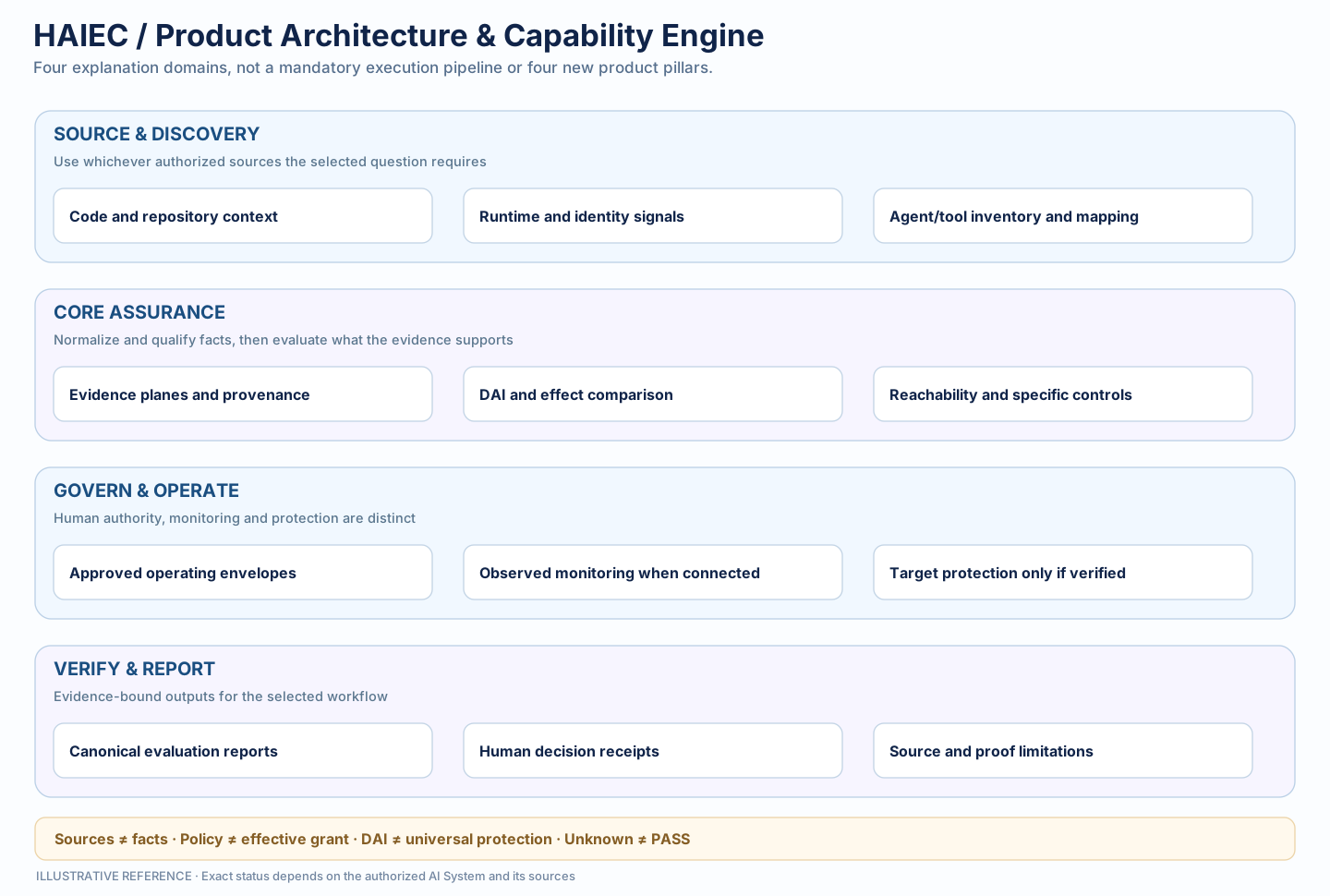
Not every artifact counts. Provenance, source admission, relevance, coverage, freshness and contradictions decide what becomes qualified input. An unmarked record is never silently promoted into a typed fact.
Policy, permission and actual authority to choose are different questions. A valid credential establishes what the credential evidence supports, not that a person delegated a specific consequential choice. The policy-versus-delegation comparison is bounded by the delegation evidence actually admitted.
Exact agent, tool, handler and resource relations are reconstructed from supported source and connected evidence. Transitive paths and ambiguous joins stay explicit; a structurally present path is not a proven execution.
Identical frozen inputs, rules and versions produce the same conclusion. Reproducibility applies to the evaluated evidence set, not to changing external systems.
Every result declares what is established, partially supported, unassessed or unknown. Canonical reports and verification receipts bind to their exact scope and integrity contract; a receipt proves the artifact, not external enforcement.
A fictional support agent can call a refund endpoint. The source path is established; the credential may permit the call. Whether anyone delegated the choice of recipient is a separate evidence question. In this example that delegation evidence is absent, so the bounded conclusion is review, not a fabricated safe verdict.
ESTABLISHED in this fixture
Code-capable path
PARTIAL, scoped to the grant evidence
Credential scope
UNKNOWN, no delegation record admitted
Delegated choice
REVIEW, illustrative only
Bounded conclusion
Fictional, illustrative. Not an executed customer evaluation.
Ask your AI to run HAIEC AI Assurance
Requires a configured MCP client, scoped credentials and a read-only eligibility preflight before any authorized run.
HAIEC does not claim universal discovery, complete visibility, automatic safety, compliance certification, or proof that every possible delegation or runtime action occurred. Framework mapping is not certification. Unknown is not pass.
Research foundation: explore ISAF v2, the instruction-to-consequence accountability framework.